
 1 week ago
2
1 week ago
2
SEE YOUR AD HERE
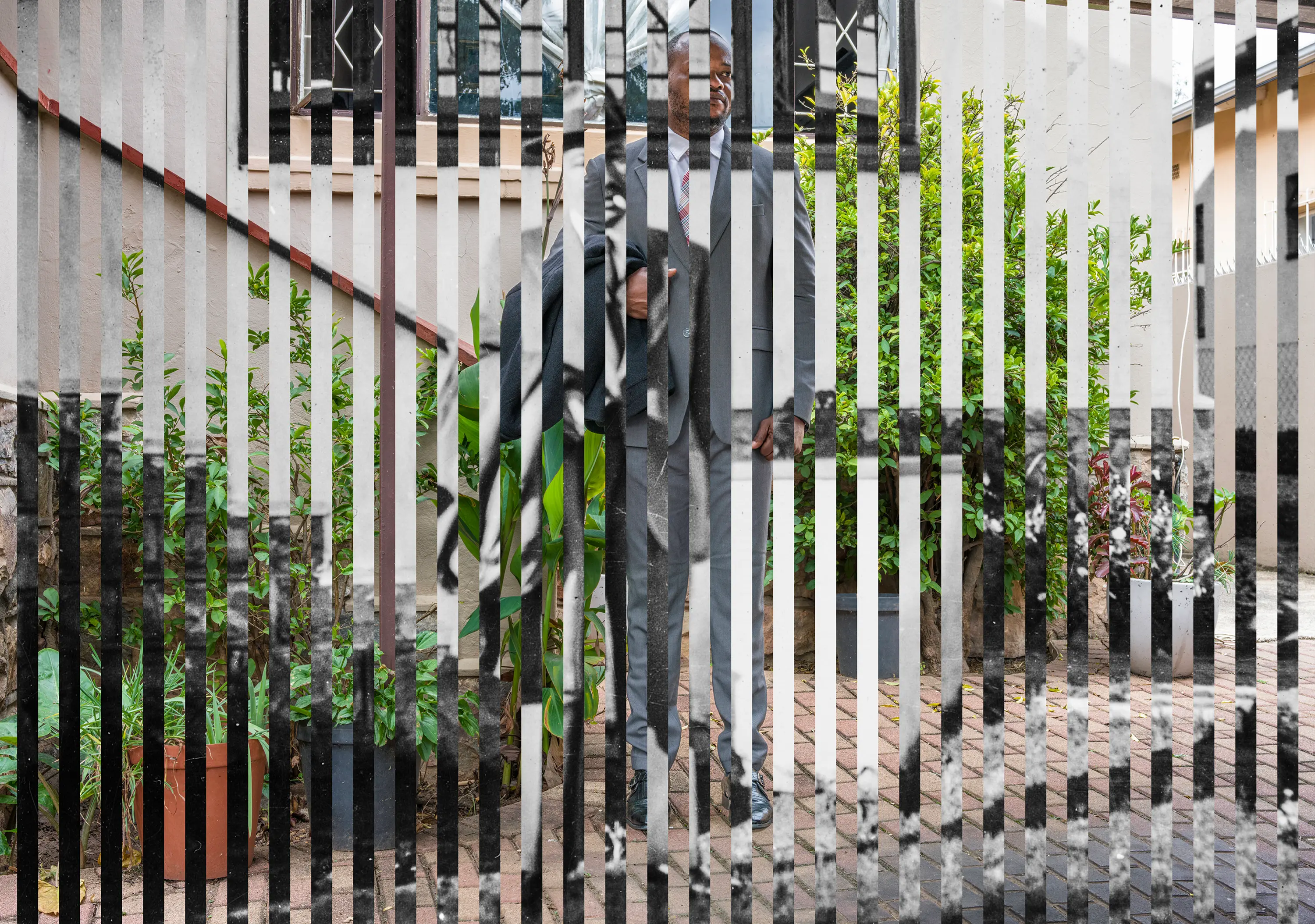
Mikhael Subotzky’s relationship with photography is as complex as that to Johannesburg, a city he first experienced at 27. Photos: courtesy of the artist and Goodman Gallery.
Johannesburg has a way of getting under your skin. Many Capetonian refugees have expressed surprise and awe at the way the city seems to creep into one’s heart. Being born and bred here, I will never know what it’s like to live in this city for the first time.
Driving to Mikhael Subotzky’s studio space at Arts on Main in Maboneng takes me less than 15 minutes if I’m travelling from my childhood home. As with many places in Johannesburg’s centre, there are multiple ways to get there, all with their own obstacles. My route takes me through Bezuidenhout Valley and up to the main road that goes past Darras Centre. I never knew its name before; only what it looks, feels and smells like.
I park inside, next to the 1976 Mercedes-Benz that is going to be featured in the exhibition as viewers enter Goodman Gallery on opening night. The car is buttercream-yellow with moss-green leather seats and original rims. Old school, just like my car, which I inherited from my grandmother, who inherited it from her late husband, my mother’s father.
Subotzky’s relationship to Johannesburg is layered and multigenerational. In many ways, his journey to settling in the city is almost like a homecoming. In the early 20th century, Subotsky’s great-grandfather was forced to make an impossible decision as a Jewish person in Nazi-Germany. He boarded the Woermann Line and travelled to South Africa, selling the 13-ton steamroller he’d brought with him and using the funds to settle in Johannesburg. Hence the second part of the show’s title: Thirteen Tons Settled to Brick.
The story of Subotzky’s family is not unique. Many families, particularly those in South Africa, have a layered and multigenerational arc which follows migrations, marriages, births and deaths. This history forms a critical aspect of the exhibition’s thesis argument. Subotzky calls it a “transmutation of privilege” in our conversation while he takes me through the process of how he created An Idea of Africa.
The piece is the exhibition’s opener, featuring an upside-down map of the continent, painted over with abstract shapes, tracing the artist’s great-grandfather’s voyage from Nazi-Germany. A detailed drawing of the Woermann Line features in the original map that the artist has used as the base of the painting. Now upside down, the ship hangs suspended in the top right-hand corner, birdlike.
I asked how he found his way to painting because it seems like a departure from his usual medium of photography. Subotzky smiles and says it happened almost by accident. In many of his collages, one of the methods he uses to distort and distress the images is taking a wet sponge to the blown-out prints, scraping and moving the pigment and leaving ghostly remnants. “Eventually, I had to admit that what I was doing was closer to painting than anything else,” he says.
It interests me that this is one of the last works Subotzky shows me when I visit his studio, given that this is where his story of Johannesburg begins. But perhaps there is something unconsciously intentional about this — it reminds me that time is cyclical, that history constantly repeats itself.
The main work, A Johannesburg Landscape, features a panoramic collage, 10 panels wide and was created using Subotzky’s signature sticky-tape transfers. He scales photographs he took himself and found, along with archival images and prints them on paper before placing archival tape on the paper’s surface, lifting the pigment in long strips, which are then layered to create weaved collages of multiple images. The method blurs the lines between past and present as multiple images exist in parallel with one another, interlocking to create an intuitive mosaic. Subotzky says the method allows the works to “approach a personal honesty”.
“It involves ripping open the image, splitting it, essentially.”
I am struck by how much the images represent Johannesburg’s multilayered history as a city on the frontier.
“It is still very much a frontier city,” says Subotzky. The past is visible through the cracks of the city’s foundations, painted over but not gone. Given Johannesburg’s history as a mining town, it makes sense that A Johannesburg Landscape has two parts — the upper city and the lower city. Archival photographs of miners are weaved into images of a desolate park somewhere in Johannesburg’s outskirts, where white tents house immigrant families fleeing xenophobic violence in the inner city. The work reflects Johannesburg’s fragmentation and its honesty.
Subotzky’s relationship to photography is as complex as his relationship to the city.
“I became an adult here,” he says. “Even though my story in Johannesburg started only when I was 27.”
Subotzky’s literal deconstruction of photographs into smaller parts reflects his own interest in the way photography is often used as a tool for representation. But of course, there are always layers to this. Who gets to hold the power? Who is the photographer representing? A lens is only so wide and can capture only what the photographer allows. Subotzky understands the complexity, which is perhaps why his instinct is to “climb inside” the photographs, to rip them open and see what lies beneath.
I ask about one of the panels, which features what looks like a mountain. Plump bougainvilleas and Angel’s trumpet hang over brick walls, interlocked with archival images of the city centre. It resembles a tourist postcard of Mount Fuji.
“That’s actually a mine dump,” says Subotzky, referring to what I thought was a mountain.
Inadvertently, I stumbled right into representation’s trap — and therein lies Subotzky’s thesis. He is far more interested in what photographs do, rather than what they merely represent.
This is the first time Subotzky’s writing will be featured in the exhibition as a work in its own right. The poem traces his personal history and reflects on his family’s relationship to Johannesburg. In all of it, like the delicate lines that Subotzky draws across the 10-panel landscape, connecting the dots and drawing our eyes across the city’s expanse, Johannesburg beats like a pulse. Something about the place captures the hearts that come across it.
When I ask Subotzky about the poem, he tells me that it’s been in the works for many years. One of the lines in the poem simply reads: “Gravity”. The line was originally meant to be “freedom eventually found” but Subotzky decided to change it as the poem evolved and revealed more of its centre. Freedom as gravity, as settling, is something that is often overlooked when talking about the concept of being free. Like the upside-down ship, winged and appearing to take flight, perhaps the true nature of freedom is the ability to finally be still.


 English (US) ·