
 2 hours ago
1
SEE YOUR AD HERE
Bitupan Deka was out shopping for a “gamusa” (traditional scarf) with his mother in India’s northeastern state of Meghalaya when he noticed something unusual.
“Every shop selling the scarf had the same handful of patterns repeated over and over,” he told Al Jazeera over the telephone from Shillong, the capital of Meghalaya.
Recommended Stories
list of 4 items- list 1 of 4How US tariffs are unraveling India’s textile industry
- list 2 of 4Photos: Weavers of India’s famous Banarasi sari are struggling
- list 3 of 4Fast fashion and the dark side of textile recycling in India
- list 4 of 4AI tool helps stranded protesters find their way home in the Indian capital
“When I asked around, I found that weavers in Sualkuchi [district in neighbouring Assam state] are paid a one-time fee of roughly 2,000 rupees [$21] for each design they develop, instead of royalties. Cutting down the number of designs they produce was a cost-saving practice followed by the manufacturers.”
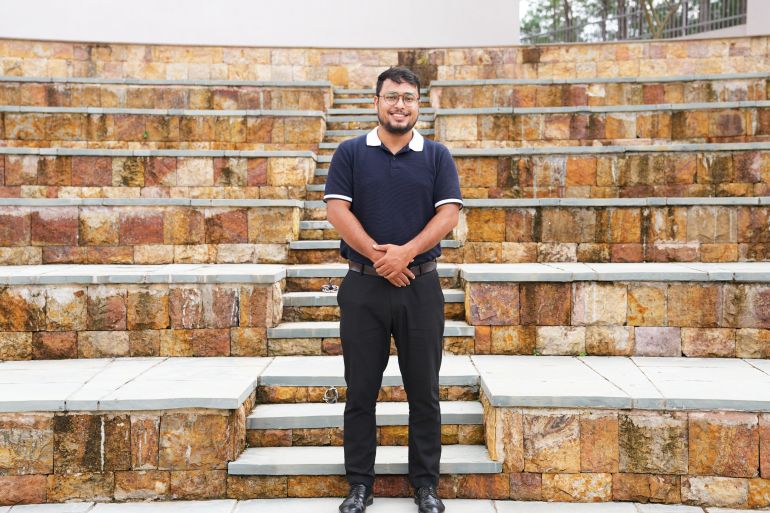 Bitupan Deka [Courtesy of Bitupan Deka]
This discovery prompted Deka, an assistant professor of computer technology at Shillong’s MIT University, to create a system that can produce infinite new designs for such fabrics.
“My work isn’t meant to replace the traditional designers. I hope, instead, that it will become a tool in their hands to create new and modern motifs more easily, so the consumers can have variety,” Deka said.
Once the patent, which is being applied for under the research and development department of his university, comes through, Deka plans to monetise the system by making it a commercial designing service that the textile industry can avail.
In India’s varied textile traditions, patterns and motifs carry the memory of a place and the mythology of its people – sometimes even the history of migrations.
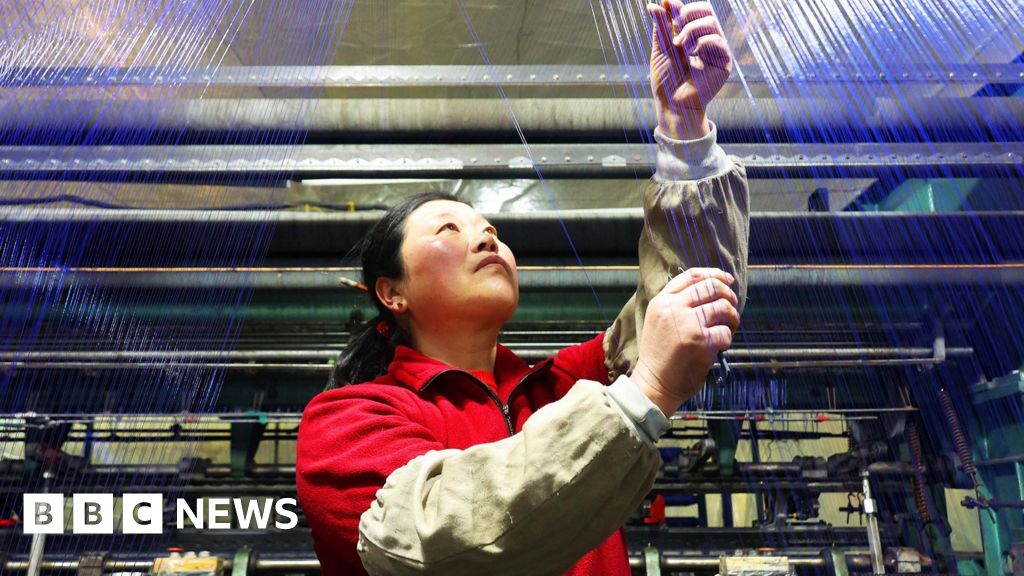
The designs are imagined by weavers from things that exist around them, and then painted with locally available colours, mostly using carved clay and wooden frames. These weavers do not simply reproduce a pattern; they inherit it. Their hands hesitate where their grandmother’s did, and they know why a particular flower must face left.
A computer has no such inheritance or hesitation. It learns by analysing pictures and repeating them in endless variations. And yet, as Deka’s system shows, the computer can now draw and weave the same flower.
The Rekh Sanganeri Dataset is a similar system developed for hand-block printed Sanganeri textiles from the western Indian state of Rajasthan. It includes high-resolution images of printed patterns, annotated down to ink bleed and slight misalignment – the imperfections that are the hallmark of the handmade work.
Its developer, Reddy Sai Nivas C, says it should be used as a resource for research and art, not as a substitute for artisans.
But the disclaimer is the paradox: Tools built to preserve a craft are making its visual language easier to digitally reproduce without involving the craftsperson.
Dinesh Chhipa comes from one of the oldest Chhipa families, an artisan and merchant caste renowned for dyeing and block printing. He is a Bagru designer – a block printing technique from Bagru town in the western state of Rajasthan – and a textile businessman.
“Traditional craft is slow to produce. Even if someone offered us a fortune, we wouldn’t be able to produce these pieces in mass numbers, so I don’t fault those using digital technology and AI to fill the gap,” he told Al Jazeera.
“But don’t borrow craft and regional names like Bagru and Jaipuri [named after the capital city of Rajasthan]. These designs and motifs were born out of a culture and necessities of the communities they come from.”
 Dinesh Chhipa is a Rajasthan-based artisan and merchant [Courtesy of Burgoyne Original Masters]
Who owns culture when it turns into plain data?
India has been digitising its textile memory for years – from the Botanical Survey of India’s historical collections to the Bharatiya Vastra Shilpa Kosh, a national portal built by the state-run National Institute of Fashion Technology and the Centre for Development of Advanced Computing (C-DAC).
Without documentation, the fragile traditions and knowledge could disappear. But digitisation also allows the same archive to be used by an AI system seeking to reproduce these crafts at scale.
At the India AI Impact Summit in New Delhi in February this year, Indian software company Tata Consultancy Services (TCS) showcased Bridgital Loom, an AI system that converts textile designs into loom-ready instructions. LED lights on the loom guide a weaver through the thread sequences of intricate Banarasi and Kanchipuram patterns – named after the cities where these iconic arts grew.
TCS says the technology helps weavers execute complex designs faster and with fewer errors, and is meant to be a bridge between the artisans and technology. A pilot project that uses the loom is already under way at Kanchipuram, a town in southern Tamil Nadu state.
In an interview with the online platform Digit at the New Delhi summit, the head of AI strategy at Bridgital Loom, Muthulakshmi Nellaiappan, pointed out that a new weaver takes more than 15 years to master the art.
“With the technologies we have in hand … the younger weaver who has just entered the skill can become a master much sooner,” she said.
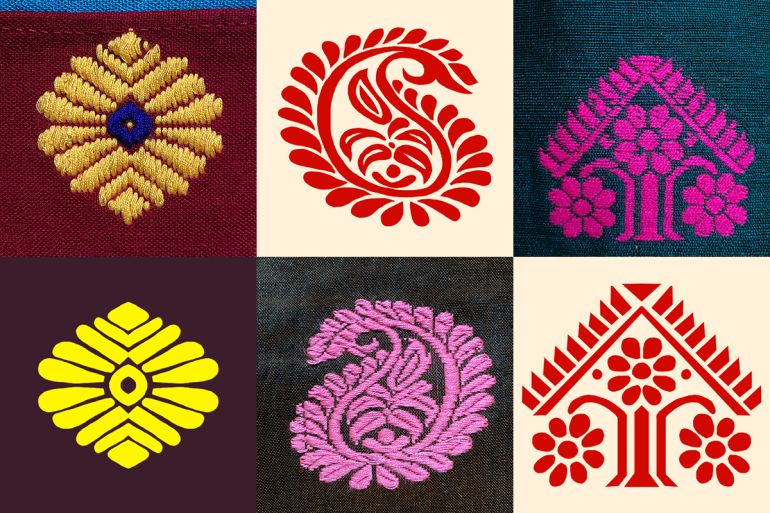 Several classic Indian motifs used by traditional weavers [Courtesy of Burgoyne Original Masters]
Technology flattens the master-apprentice hierarchy of traditional knowledge systems. The weaver no longer has to conceptualise or remember patterns, colours and codes; he blindly follows the machine’s instructions, handing creativity and memory to AI.
Nellaiappan said that since a large percentage of India’s looms are non-electronic, TCS has ensured its system works with handlooms as well and that it was essential for scaling up the technology.
But digital looms also raise another question: Who owns culture when it turns into plain data?
For generations, India’s textile knowledge sat outside intellectual property systems. It lived in community memory, passed from master to apprentice with no certificate of ownership. Kanchipuram, Mekhela-Sador, Sanganeri and Banarasi are names for places that these textiles helped shape, not merely emerged from.
Now, this knowledge is entering generative models that owe nothing to these traditions.
For designers and manufacturers, the possibilities are seductive: Motifs combined at will, colours changed with a command, and thousands of designs generated instantly. The machine offers abundance.
The artisan, on the other hand, has always lived with scarcity: Of money, bargaining power, or recognition.
Ananthalakshmi Vadivel, a third-generation weaver and owner of Vadivel Silk Looms in Kanchipuram, says their venture is already competing in the market with cheaper Kanchipuram sarees produced on electronic looms.
“Perhaps, with AI, these sellers can create trending designs faster and cheaper to attract mass consumers. But these imitations can never replace the original,” she told Al Jazeera.
“There will always be a market for authentic Kanchipuram and handcrafted textiles, no matter how much technology makes the imitation cheaper. True Kanchipuram weave, colour, and designs can only be created by hand, and discerning buyers know this.”
Then again, the question is no longer whether AI can recreate a textile. It sure can. The question is: Who gets paid when it does?
Legal gaps
In December 2025, the federal government’s Department for Promotion of Industry and Internal Trade floated a statutory “blanket licence” – a system where AI developers could train models on lawfully obtained copyrighted material without seeking permission from each rights holder. Once commercialised, those systems would owe royalties to copyright owners at rates set by the government.
But intellectual property (IP) laws assume a traceable work with a traceable author. A motif, on the other hand, is communal property, its technique passed down through generations with no single originator.
In such cases, who is entitled to royalty and copyright? The artisan who first created the design? The photographer who documented it? The researcher who assembled the dataset? The developer who built the tool? India’s laws offer no clear answers. The artisan whose name never appeared on a label may once again be missing from the paperwork.
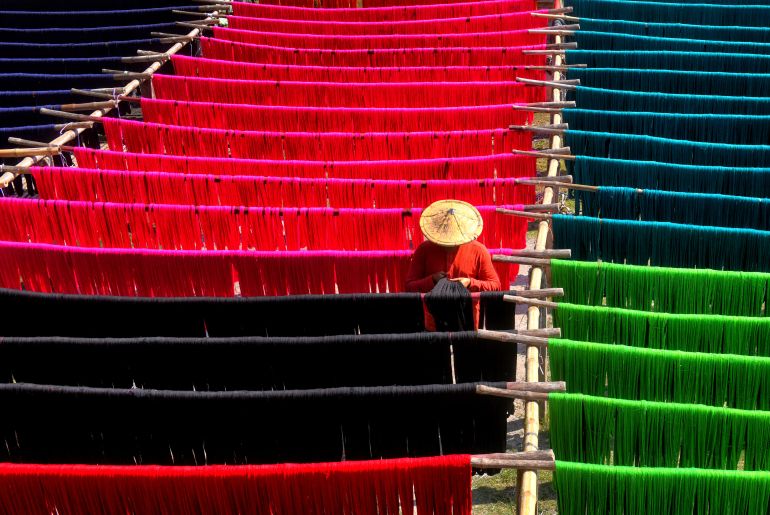 A weaver in West Bengal state rinses the colourful jute fibre to dry under the sun, which will be used to extract threads to make handloom dresses [Avishek Das/SOPA Images/LightRocket via Getty Images]
Meanwhile, the government is planning a dedicated AI-handloom research department under the Centre of Excellence for Handloom Technology at the Indian Institute of Technology (IIT) in the capital, New Delhi. Inaugurated in August, the $1.4m facility aims to modernise India’s handloom sector by combining traditional weaving heritage with contemporary technology.
The government also plans to register thousands of weavers and fit their handlooms with sensors that convert weave patterns into digital data, and issue QR-coded tags to trace provenance. Maharashtra’s Vingatha system does something similar at the state level by authenticating handloom sarees such as Paithani and Karvat Kathi.
The idea is simple: If a saree can tell you where it came from, the person who made it becomes harder to erase.
While these measures cannot stop AI-enabled design and mass production, they may give artisans more visibility and turn each piece into an archive.
In art galleries, the traditional textiles are increasingly shedding the label of craft for the more lucrative category of contemporary art.
Gurjeet Singh, an artist from Chandigarh city, recently hosted a textile-based solo show in New York. His work transforms discarded fabrics, buttons and embroidered scraps into sculptures that explore queer identity and social prejudices surrounding gender and sexuality.
Sayan Chanda, an Indian artist based in London, works with cut and rewoven vintage Bengali quilts to question fixed notions of cultural belonging. Gurugram-based artist Sumakshi Singh uses delicate embroidery and suspended thread structures to reconstruct the architectural fragments of vanished homes, gardens and personal histories. There are many more.
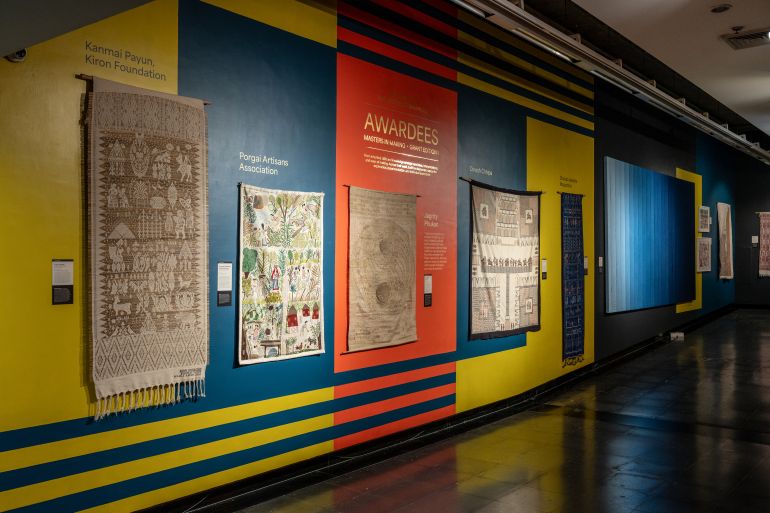 An art gallery in New Delhi displaying some weaving traditions [Courtesy of Burgoyne Original Masters]
In New Delhi, 20 such artisans and craft-led collectives featured last month at an art show celebrating the traditional textile crafts.
“Our aim is to present these traditional crafts as living practices that continue to evolve through contemporary artisans, rather than as heritage to be archived. Kanmai Payun, one of the artists featured in the show, for example, is the last practitioner of Fulor Saneki, a flower pattern used by Assamese weavers. We encouraged her to teach her 17-year-old son so the craft outlives her,” Aparupa Ray Ganguly, the curator of the show, told Al Jazeera.
But as textiles gain value in art galleries, their makers do not necessarily gain automatic control over their work.
In April, another art exhibition in New Delhi, titled No ‘One’ Maker, saw artisans missing from the show’s preview, exposing how traditional textiles are aestheticised, but the people who carry that knowledge remain unrecognised.
“You cannot separate the names from the community. Call your mass-produced work digital prints and leave the traditional names to the original artisans,” says Chhipa, the artisan and merchant from Rajasthan.







 English (US) ·