
 2 hours ago
1
2 hours ago
1
SEE YOUR AD HERE
"We built this campaign brick by brick"- Abdul El-Sayed speaks after winning Michigan Senate primary
By
North America correspondent
The tremors from Abdul El-Sayed's victory in Michigan's Senate primary will have been felt hundreds of miles away by the Democratic Party leadership.
In a year in which Republicans appear to be facing significant electoral headwinds, Democratic primary voters have taken a chance on a left-wing insurgent, raising the stakes in a Senate race in November that could decide overall control of the upper chamber.
The question is whether the way El-Sayed has electrified the party base and tapped into their anger will work on general election voters. And whether an unabashedly left-wing Democrat can win in a swing state.
The party establishment, which had backed his opponent, will hope so.
Primary results across five states on Tuesday were a snapshot of the mood of the American electorate three months before the midterm elections.
Here are four key takeaways from the results.
1) A new left-wing warrior
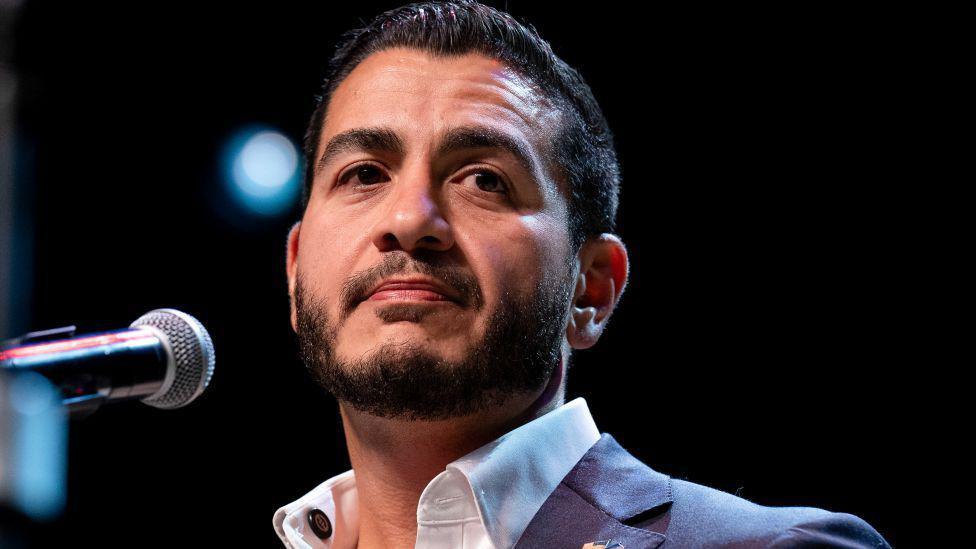 Image source, Getty Images
Abdul El-Sayed's victory on Tuesday night in Michigan's contentious Democratic primary race for Senate was hardly a surprise. He had led by a comfortable margin over Congresswoman Haley Stevens for weeks.
While the final projected result was much closer than those surveys had suggested, again raising questions about modern polling accuracy, it doesn't diminish the shockwaves the victory of the former Michigan health official is sending throughout the Democratic Party.
El-Sayed, the child of Egyptian immigrants, ran on a left-wing platform with the backing of such liberal stalwarts as Senators Bernie Sanders and Elizabeth Warren and Congresswoman Alexandria Ocasio-Cortez.
Stevens had the backing of Democratic leadership in Washington, an established record as an elected official in Michigan and deep financial pockets, including $32m from Aipac -the American Israel Public Affairs Committee. Outside groups favoured her over El-Sayed by a margin of nine-to-one.
None of it mattered.
In debates and on the stump, El-Sayed proved to be the more gifted candidate, and Democrats seemed open to his policies, including government-sponsored health insurance, efforts to lower drug costs, higher taxes on the wealthy and campaign finance reform.
His campaign refrain - "money out of politics, money in your pocket" - has been a common one among left-wing candidates this election cycle.
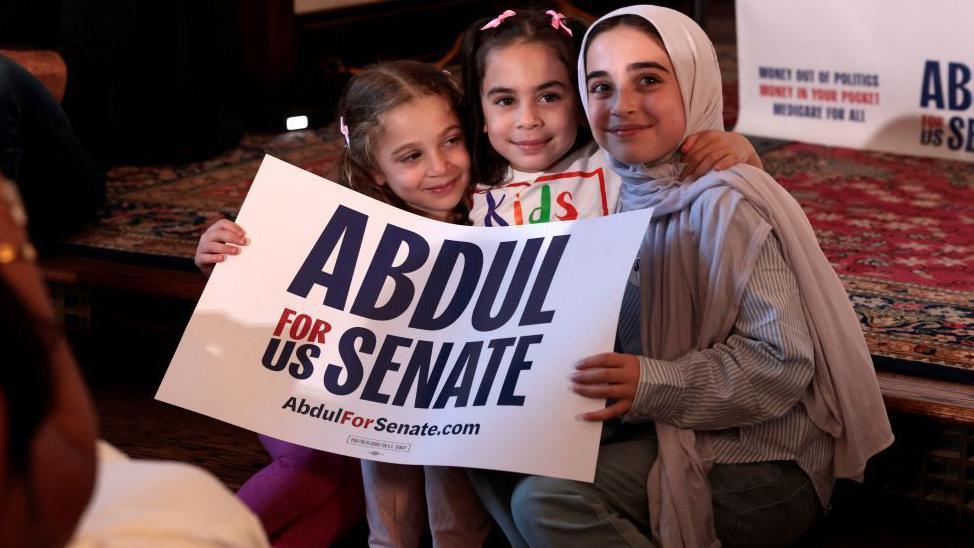 Image source, Getty Images
Young supporters in Detroit hold a sign in support of El-Sayed
This sets up a general election contest against former Republican Congressman Mike Rogers, who ran unopposed. It will provide perhaps the most dramatic, high-stakes test of whether a left-wing candidate can win a general election race in a true battleground state.
Given the narrowness of El-Sayed's primary victory, he has considerable work ahead if he wants to unite the party before November's vote.
While El-Sayed did well with higher-educated liberals, he'll need to win over the lower-income voters who backed Haley in Detroit and in more rural areas. These are voters whose preferences the pre-election polling did not seem to adequately reflect.
If El-Sayed loses to Rogers, it could deal a mortal blow to Democratic hopes of retaking control of the US Senate, as a Republican hasn't won a Senate race in Michigan since 1994.
If he wins, however, it could provide left-wing Democrats with proof of concept for why a left-wing candidate for president in 2028 could be more successful than the kind of establishment centrists the party has nominated in recent contests.
And with Michigan's position as a key early state on the Democratic presidential primary calendar, the state will have an outsized say in who the party's nominee will be.
2) Some pro-Israel Democrats had a bad night
Stevens was the highest-profile Aipac-backed candidate to lose on Tuesday night. In lesser-watched races, the results were more mixed.
Elsewhere in Michigan, Democratic Socialist Donavan McKinney beat incumbent Shri Thanedar, who has been an outspoken supporter of continued US support for Israel. He became the latest party House incumbent to be ousted in the primaries.
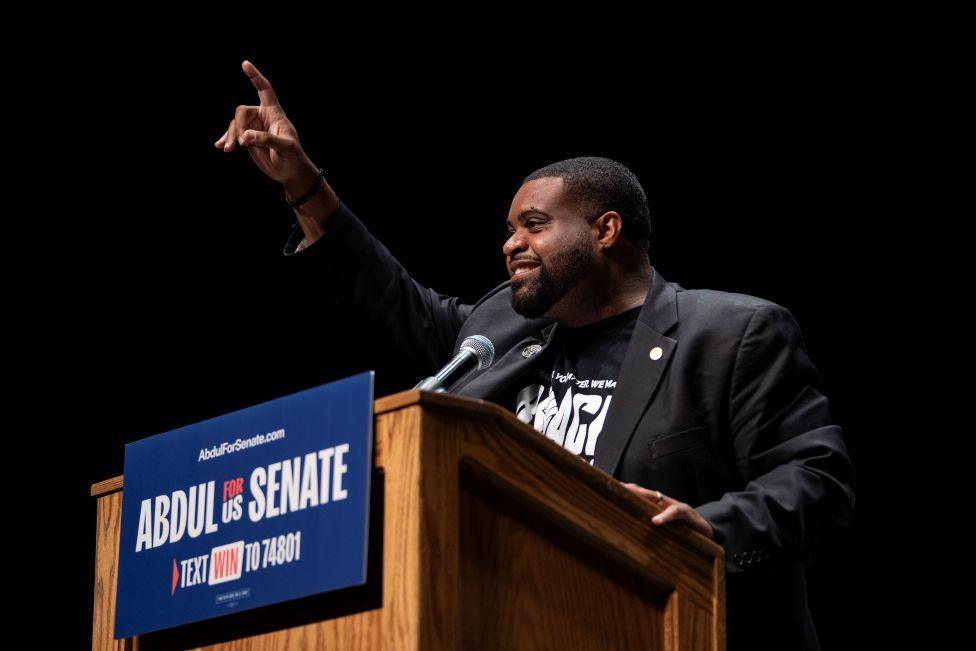 Image source, Getty Images
McKinney and El-Sayed supported each other's campaigns
William Lawrence, who has called for an immediate end to US arms sales to Israel, defeated two centrist Democrats in a House of Representatives district in Michigan that is likely to be a key electoral battleground in November.
If the mood of the Democratic voters has soured on pro-Israel politicians in Michigan, and in previous races in New York and Colorado, that was not the case in the Missouri and Washington results.
In Washington, Congresswoman Marie Gluesenkamp Perez, who supports military aid for Israel, easily turned away a left-wing challenger. She is one of the few Democratic incumbents in districts Trump won in 2024 - and will be a prime target for Republicans in November.
Meanwhile, in a solidly liberal Missouri district, Wesley Bell denied a comeback bid from Cori Bush, a founding member of the "squad" of left-wing congresswomen. Two years ago, he unseated her in part because of her criticism of Israel.
3) Voters reject Republican measures in the Midwest
While most of the contests on Tuesday night were intraparty primary fights, there were a couple of notable votes that could provide evidence that the overall mood of the electoral continues to tilt toward the Democrats.
In Missouri, voters overwhelmingly rejected a ballot measure that would have made citizen-backed amendments to the state constitution more difficult to enact.
In recent years, such citizen-driven efforts have been used to push Democratic initiatives that had no chance of passage in the Republican-controlled state legislature. They include protecting abortion rights and raising the minimum wage.
Meanwhile in Kansas, voters rejected a ballot measure that would have have required the state's supreme court justices to stand for election. At the moment, they are appointed by the governor and a commission of lawyers.
In 2024, the state high court had ruled that the right to abortion was protected by the Kansas constitution - a decision Republicans said was out-of-step with the will of state voters.
Both efforts were pushed by state Republicans and, in both cases, the proposals were easily defeated.
4) Trump's endorsement still (mostly) matters
It was largely a good night for Trump-backed Republicans, who earned a few victories in their primaries.
John James won Michigan's Republican nomination for governor despite being heavily outspent by his wealthy opponent. Trump not only endorsed James but appeared on stage with him last week.
In Kansas, Republicans opted for the Trump favourite for governor amidst a crowded field. And in the Washington state race to replace outgoing Republican Congressman Dan Newhouse, Amanda McKinney, the president's pick, also finished first.
The 71-year-old Newhouse, who is retiring, was notable for being one of the last two remaining House Republican to have voted to impeach Trump after the 6 January, 2021 attack on the US Capitol.
Given that this is a reliably conservative district, McKinney is a favourite to defeat her Democratic opponent in November, which would likely move House Republicans further to the right. It's the latest bit of evidence that old-line establishment Republicans like Newhouse are a vanishing breed.
But Trump didn't get it all his own way.
In Michigan, Thomas Smith defeated Trump-endorsed Amir Hassan, a former law-enforcement officer who also appeared on stage with the president, despite Smith having dropped out of the race last month while remaining on the ballot.

Follow the twists and turns of Trump's second term with North America correspondent Anthony Zurcher's weekly US Politics Unspun newsletter. Readers in the UK can sign up here. Those outside the UK can sign up here.




 English (US) ·