SEE YOUR AD HERE
Johannesburg, South Africa — April 29, 2026
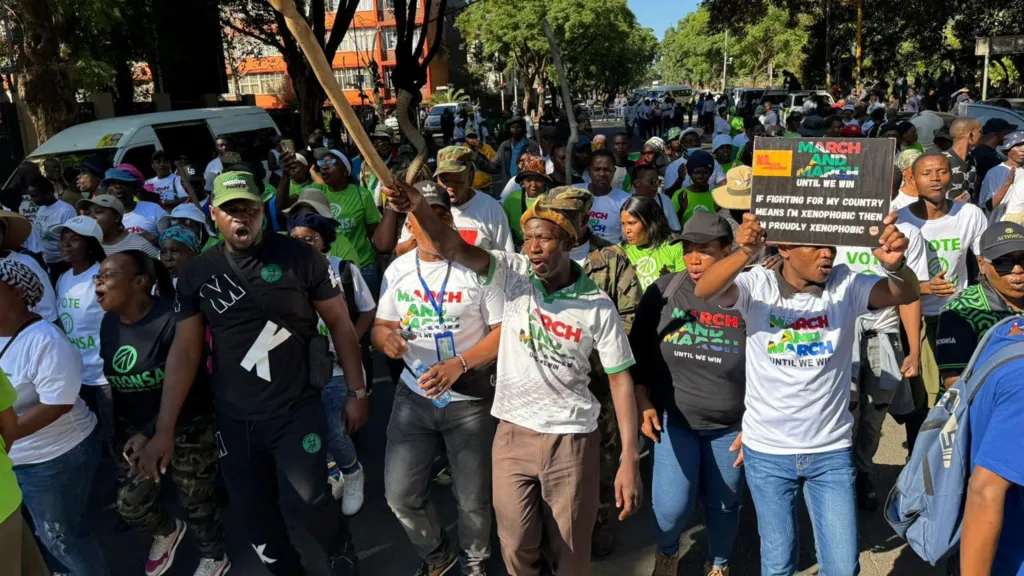
1. Ground-level dateline — Hundreds of demonstrators led by the group March and March, operating alongside organisations such as Operation Dudula and ActionSA, barricaded major thoroughfares in the Johannesburg Central Business District today, forcing widespread shop closures in protest of undocumented migration, demanding immediate mass deportations, and delivering a formal memorandum of demands to the Gauteng Legislature.
2. Local context South Africa is currently navigating its most volatile socio-political transition since the formal dismantling of apartheid. The formation of the Government of National Unity (GNU) has forced disparate, historically opposed political factions into a fragile governing coalition operating under intense public pressure to address an unemployment rate that hovers near 32%, alongside pervasive, systemic economic stagnation. Historically, African foreign nationals have been scapegoated by both political elites and disenfranchised citizens for the state's severe service delivery failures. Groups like Operation Dudula, which successfully transitioned from a vigilante street movement executing unlawful evictions to a registered political entity ahead of the 2024 elections, have entrenched hardline xenophobic rhetoric into the mainstream political discourse of the nation. South Africa operates as the primary economic magnet within the Southern African Development Community (SADC), having historically relied on migrant labour from neighbouring states to sustain its massive mining and agricultural sectors. However, systemic spatial inequality and the proliferation of hijacked inner-city buildings have transformed urban centres like Johannesburg and Pretoria into violent flashpoints for conflict between impoverished citizens and highly vulnerable migrants.
3. Key developments Today's intense protests in Johannesburg, which necessitated extensive road closures through critical arteries such as Jeppe and Loveday streets by the Johannesburg Metropolitan Police Department (JMPD), closely mirror similar, highly disruptive demonstrations that occurred in the capital city of Pretoria yesterday. Concurrently, the South African Cabinet has officially approved the Revised White Paper on Citizenship, Immigration and Refugee Protection following extensive consultations led by the Department of Home Affairs. This sweeping policy document introduces the "First Safe Country Principle," effectively disqualifying asylum seekers who transited through safe third countries before reaching South Africa from claiming protection. Furthermore, the Department of Home Affairs, under the direction of Minister Leon Schreiber, confirmed this week that deportations have surged to nearly 110,000 since the GNU's formation, marking a massive 46% increase over the past two financial years. Concurrently, state labour inspectors have audited over 7,600 businesses, officially charging 2,100 employers for the illegal hiring of undocumented foreign nationals.
| South African Enforcement Metrics (2024-2026) | Verified Figure | Policy Context |
| Total Deportations (24 Months) | 109,344 | 46% cumulative increase post-GNU formation. |
| Business Inspections Conducted | 7,600+ | Intensified labour compliance operations. |
| Employers Criminally Charged | 2,100 | Penalties for hiring undocumented nationals. |
4. Power & incentive analysis The convergence of violent anti-immigrant street movements and official, highly restrictive state policy illustrates a dangerous political feedback loop where vigilante demands expedite legislative tightening. Political parties such as the Patriotic Alliance and ActionSA leverage xenophobic sentiment to consolidate their voter base among the deeply impoverished South African electorate, strategically framing the eviction of foreign nationals as a rapid panacea for the nation's severe housing and employment shortages. For the Department of Home Affairs, the implementation of strict enforcement sweeps and the transition to a points-based economic migration system serve to project state capacity, appease the electorate, and restore the perception of the rule of law. Conversely, undocumented migrants, asylum seekers, and even documented foreign nationals face catastrophic systemic exclusion and constant physical danger. Human rights organisations, including Kopanang Africa Against Xenophobia (KAAX), find their operational space rapidly shrinking as the state aligns closer with populist demands, while local employers face heightened regulatory costs, professional audits, and direct criminal liability.
5. Regional & global links South Africa's aggressive policy shift structurally alters the entire SADC migration corridor. The introduction of the "First Safe Country Principle" directly emulates European externalisation strategies, forcing neighbouring transit states such as Zimbabwe, Mozambique, and Botswana to absorb asylum seekers who were traditionally destined for the economic hubs of South Africa. Globally, the shift toward a merit-based, points-based system for remote work, start-up, and skilled worker visas aligns South Africa with frameworks utilized by highly developed nations like Canada and Australia. This indicates a definitive pivot toward prioritizing highly skilled global talent while actively criminalising and repelling low-skilled regional economic migrants from the African continent.
6. Implications In the immediate short term (the next 7 to 14 days), the Johannesburg CBD and surrounding townships will likely experience rolling, unpredictable disruptions, carrying an elevated risk of opportunistic looting and targeted, lethal violence against migrant-owned commercial enterprises, particularly local spaza shops. Employers across the agricultural and hospitality sectors will rapidly shed undocumented labour to avoid the intensified Home Affairs audits, driving thousands of migrants further into the unregulated underground economy. In the long term (over the next 12 to 36 months), the implementation of the Revised White Paper will heavily restrict basic asylum access. The strategic withdrawal from certain international refugee conventions, coupled with mass deportation campaigns, threatens to severely strain bilateral diplomatic relations with regional neighbours whose fragile economies depend heavily on the remittance flows generated by their citizens working in South Africa.
7. Sources
[International] AP News: Hundreds march in Johannesburg against illegal migration
Daily Maverick: Joburg migration politics shows failure of real leadership
[Institutional] KPMG / Government Gazette:(https://kpmg.com/xx/en/our-insights/gms-flash-alert/2026/flash-alert-2026-113.html)
Photo cred: Rosetta Msimango|News24




 English (US) ·