 3 days ago
1
3 days ago
1
SEE YOUR AD HERE
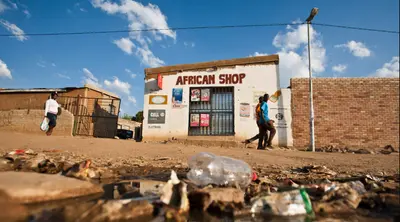
Groups such as March and March and Operation Dudula have issued a 30 June ultimatum for African immigrants living in South Africa to leave the country, accusing them of ‘stealing’ their jobs and committing crimes. However, their anger is misdirected. The challenges they are experiencing are symptoms of a deeply unequal and rigged economic system
26 JUN 2026, 00:00
4 min read

Some South Africans are pouring into the streets, furious at unemployment levels, collapsing public services and rising crime.
Their anger is justified but dangerously misdirected. African immigrants are not their enemy. They are their fellow comrades trying to survive the very system choking them.
The real culprits that South Africans and Africans must unite against are billionaires, corporations and ruling elites — the 1% who hoard wealth while the 99% suffer.
South Africa stands at the frontline of global inequality. The super-rich have connived with the ruling elite and rigged the economic system to work against Africans while enriching themselves.
The richest 10% hoard nearly all the nation’s wealth while the majority remain on the periphery. The skewed economic system in the country dictates who works, who owns and who thrives. Townships remain cut off, workers remain disposable and communities remain trapped in poverty while wealth piles up in the hands of a few.
While the context differs, the pattern is the same across the continent.
Africa is immensely endowed with minerals, a young and vibrant population, fertile agricultural land, vast forests and boundless energy, agriculture and tourism opportunities. Yet hunger, energy poverty, poor public service delivery and instability persist.
The question is not how a rich continent can be so poor, hungry and unstable. It is who orchestrates instability, controls its wealth and ensures Africans are excluded from it.
Africa is in debt distress. The continent’s total public debt is estimated at approximately $1.83 trillion, with 32 of the 55 countries spending more on repaying debt interest than on healthcare and education combined.
And this debt accumulation is not simply about governments “failing” to manage their finances. It is a predictable outcome of a global economic architecture designed to keep the continent in a cycle of dependency.
The logic is deliberate: governments are made accountable to international creditors rather than citizens; structural adjustment programmes shrink public spending and weaken domestic industries; and economies are locked into reliance on imports and external capital.
In other words, debt distress is not a symptom of mismanagement; the architecture itself benefits the 1% financial elite, multinational corporations and creditor nations, leaving the continent with economic and social instability, poverty and exclusion from its own wealth.
Political capture in Africa hardwires inequality into governance. Elites bend laws, budgets and institutions to serve their interests, diverting public resources into patronage networks while silencing grassroots voices, weakening accountability and locking citizens out of decision-making.
Instead of redistributing wealth or investing in schools, hospitals and public infrastructure, captured states entrench privilege, borrow to sustain patronage and deepen dependency to ensure that poverty spreads downward while wealth flows upward
Agriculture is Africa’s lifeline but its control has been hijacked. The fundamentals — land, seeds, markets and food systems — are not in the hands of ordinary Africans. They are locked in the grip of greedy and corrupt corporations and elites.
Corporate agribusinesses such as Bayer, Syngenta and Corteva dictate seed access and pricing and heavily promote the use of toxic chemicals that poison rivers and soils and cause underlying health effects in people.
They masquerade behind the language of modernising and commercialising agriculture to displace smallholder farming families and trap them in perpetual hunger and poverty.
Trade and agriculture policies are written for profit while climate change relentlessly batters small-scale, rain-fed farmers. As a result, food sovereignty in Africa has been destroyed and food security denied
Across Africa, countries sit on vast reserves of oil, gas and minerals, yet they face economic stagnation, political turmoil and grinding poverty.
This paradox is not a coincidence, nor merely the failure of governments to seize opportunities. It is the outcome of a rigged global economic system designed to extract Africa’s wealth while leaving its people trapped in instability and want.
Africa holds 30% of the world’s critical minerals, which are continuously shipped overseas as raw exports. This is extraction without transformation and it is harming the continent.
We must break free from the chains of raw exports. Africa can turn its strategic resources into jobs, revenue and true industrial power. This is not just economics; it is liberation.
The South African crisis must therefore be redefined. It is not an immigration crisis. It is an economic one. And it is not South Africa’s alone. It is an Africa-wide challenge forcing millions to move across borders in search of survival.
We must not turn on each other. Expelling one another only reshuffles the victims of exploitation. The fight is not against fellow Africans; it is against the architecture of greed.
Our energy must be united in building a new economic system to replace the broken one.
Daud Kayisi is the Fight Inequality Alliance Global media and communications officer.



 English (US) ·