
 1 month ago
6
1 month ago
6
SEE YOUR AD HERE

 BBC
BBC
Ellie Wight started taking ketamine five years ago
Ellie Wight started taking ketamine when she was 18.
It made her feel like she had "no worries" and "no cares", helping her to relax in social settings.
She thought it was a "safe option" compared to other drugs, and "didn't think she'd have any issues".
Five years later, the 23-year-old is living with permanent damage to her bladder caused by repeated use of the powerful class-B drug.
Ketamine is widely used in the NHS as an anaesthetic, sedative and pain reliever, and is also commonly used on animals.
Because of its hallucinogenic effects, it became known as a "party drug" though there is evidence that its recreational use is on the rise – and users are getting younger.
Ellie says ketamine was very cheap and very easy to get.
"You're paying, like £10, £20 per gram."
"At my worst I was taking 3.5g every day. That was for £40, if not less."
Within six months, Ellie, from Drumoak in Aberdeenshire, started experiencing symptoms of ketamine urinary tract syndrome, also known as 'ketamine bladder'.
"Inflammation, constantly needing a pee, I started off getting UTIs (urinary tract infections) quite a lot," she says.
"It's not something I'm really proud of, but when I was 18 years old and I'm sitting in traffic in Aberdeen, and I'm bursting for the toilet and you just physically can't hold it.
"It's a lot mentally going through that."
Ketamine is illegal to take, carry, make or sell unless for licensed medical uses.
As the drug is processed by the body and passed through urine it can cause the walls of the bladder to become irritated.
Scarring, or fibrosis, leaves the usually stretchy organ tight and constricted, meaning it is less able to fill with and hold urine.
Despite its name, 'ketamine bladder' affects the entire urinary tract, including the kidneys and ureters.
It is characterised by pain in the stomach and back, a frequent and urgent need to urinate, blood in the urine, and sometimes incontinence.
A normal bladder can hold between 300ml to 600ml of urine.
Ellie says hers can now hold just 50ml to 100ml.
She says that when she first quit the drug her bladder healed within a month or two, however, she soon returned to taking it.
"Unfortunately, this time round, it didn't heal," she says.
It is now 10 months since she took the drug and she's still managing pain caused by its use.
A UK government report published in March 2024, found that ketamine use in young people in England and Wales aged 16-24 years, had increased by 231% since March 2013.
In Scotland, similar data is not collected, but urologists say the number of children presenting with symptoms of ketamine urinary tract syndrome is "escalating rapidly".
The lack of proper data collection in Scotland is an issue highlighted by Justine Royle, a consultant urological surgeon at Aberdeen Royal Infirmary (ARI).
She told BBC Scotland that a rise in the number of patients in the north east of Scotland has led the urology department at ARI to create a specialist 'ketamine bladder' clinic.
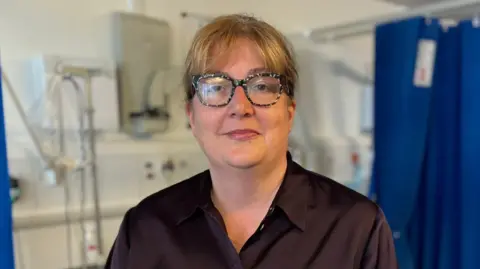
Justine Royle is a consultant urological surgeon at Aberdeen Royal Infirmary
"Initially there were one or two a year coming through," she says.
"We now see between one and two a month that have significant levels of damage to their urinary tract."
She says she thinks this is just "the tip of the iceberg" and could get much worse.
Royle says the patients she sees are "young and fit".
"Intelligent kids who have a bit of disposable income and think ketamine is not going to do them any harm," she says.
"In reality, they are damaging themselves beyond redemption."
She says children as young as 14 have been admitted to ARI experiencing symptoms of 'ketamine bladder', and in England colleagues have seen patients as young as 10.
Royle says the damage ketamine causes does not stop at the urinary tract.
"The vast majority of people who have long term usage will end up with significant damage to their bodies," she says.
"It can affect erectile function, it affects the liver, and there is some evidence that it may affect the brain in long term usage as well."
She told BBC Scotland she knows of cases handled by colleagues of cardiac arrest related to ketamine, "probably related to renal failure".
'My bladder wasn't working anymore'
Claire, not her real name, is recovering from five years of ketamine addiction.
She was first introduced to the drug about 18 and at the height of her addiction, she was taking between 14g and 21g - about £150 worth - of ketamine a day.
"It was a very dark time for me," she says.
"I was really physically unwell and in such a bad place mentally I just didn't want to be alive anymore."
Due to damage to her bladder caused by ketamine, Claire now relies on nephrostomy tubes to drain urine directly from the kidneys through an opening in the back, into an external bag that can be emptied.
For those experiencing bladder-related pain due to ketamine use, the numbing or pain-relieving effect it provides can make using it a difficult cycle to break.
"The only thing that helped with my pain was taking more ketamine," Claire says.
"You're in so much pain and you just want that relief for a few minutes.
"Both the times I've been in hospital because of my ketamine use I have gone home and used the next day."
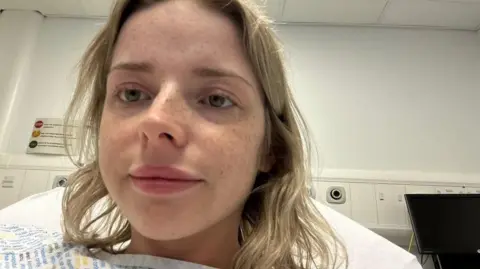
Ellie has set up a peer support group to help other people struggling with addiction
Now 10 months ketamine-free, Ellie has set up a peer support group, Safe Space Ketamine Recovery, to help other people struggling with addiction.
She says it is important for young people to be able to surround themselves with people who understand issues like incontinence caused by ketamine use.
Ellie also says she thinks young people can be naïve, adding that there is a perception that "it happened to them, so it won't happen to me".
"Maybe if it doesn't happen straight away it will come. I just think it's not worth it."






 English (US) ·