
 1 hour ago
1
1 hour ago
1
SEE YOUR AD HERE
When we turn on the foreign migrant, we are looking into a mirror. The migrant is not the source of our problems. Rather, the figure of the ‘undocumented migrant’ is both a deflection from and a reflection of them
29 JUN 2026, 15:54
9 min read

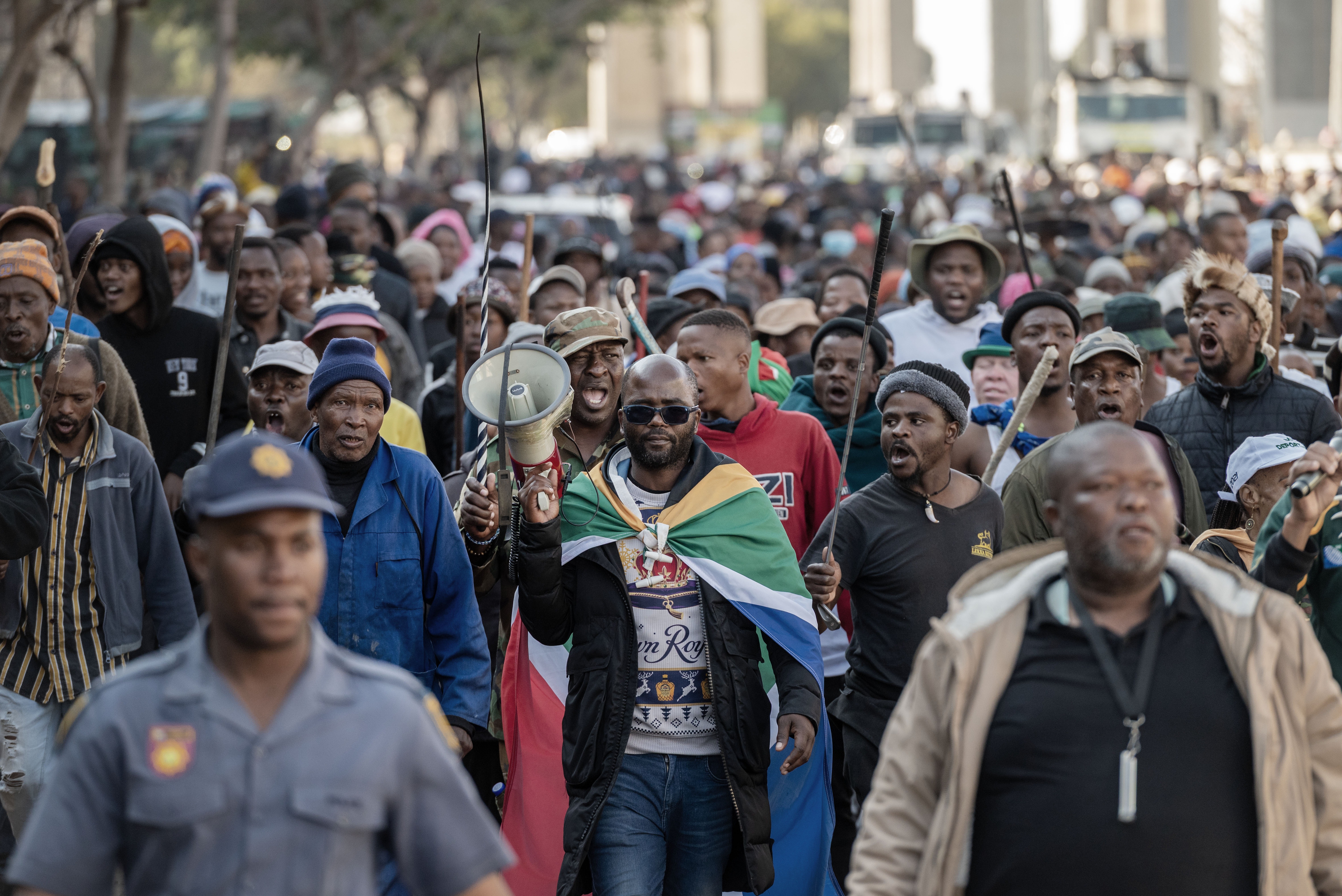
The history of violence in the twentieth century is filled with moments when societies fixated on an “Other” as the source of their problems, especially economic hardship. In Europe, the Jew, the Romani and later the Communist occupied that role; today it is often the Muslim. During apartheid, South Africa’s Other was the “swart gevaar” and the communist. In post-apartheid South Africa, it has increasingly become the migrant from elsewhere in Africa and the Global South.
The warning signs were visible in the xenophobic attacks of 2008. Today, the sentiment is more organised, with charismatic leaders and growing public support. Official responses have often resembled those of 2008: political leaders deny that xenophobia exists, NGOs mobilise solidarity campaigns and academics debate labels — is it xenophobia, Afrophobia or class conflict? While none of these responses are inherently wrong, none is adequate to the politics now unfolding.
The focus on the Other reveals a deeper political and intellectual crisis within ourselves. It reflects an unresolved struggle about what it means to decolonise a political community today. In contemporary Europe, debates about migrants are fundamentally debates about what it means to be European now: a white Christian identity or a multicultural and evolving one. In South Africa, hostility towards migrants exposes the unfinished project of building the post-apartheid society we once imagined, in which belonging is based on residency, not origins.
That project sought to decolonise citizenship. It aimed to create a society committed to democracy, equality and inclusion; but also to reduce the material gap between apartheid’s victims and beneficiaries; to dissolve urban segregation; to decriminalise Black urban life after generations of forced removals and homeland policies; to rethink patterns of land ownership; and to ensure that the country’s wealth was not concentrated in the hands of a small minority whose advantages were rooted in settler colonialism.
When we turn on the foreign migrant, we are looking into a mirror. The migrant is not the source of our problems. Rather, the figure of the ‘undocumented migrant’ is both a deflection from and a reflection of them.
It is a deflection because evidence consistently shows that South Africa’s crises stem from historical wrongs and contemporary political failures. Persistent poverty, unemployment and exclusion are rooted in the racial and ethnic structures inherited from apartheid and in our inability to transform them adequately. For too long, justice has been narrowly framed around gross human rights violations, while insufficient attention has been paid to the everyday injustices suffered by millions under apartheid’s social, political and economic order.
Similarly, accountability for apartheid has often focused on those who enforced it directly, while neglecting broader questions about those who benefited from it. Millions voted for apartheid, occupied homes from which others had been removed, inherited land acquired through conquest and passed wealth across generations. South Africa has not undertaken a sufficiently deep reckoning between apartheid’s victims and beneficiaries — not to encourage vengeance but to create a shared commitment to a more just and equal future.
There is a profound irony in the present moment. Many people now mobilising against foreign migrants were themselves, not long ago, treated as migrants and outsiders under apartheid’s internal system of exclusion. History repeatedly demonstrates where politics of exclusion can lead if left unchecked. When foreign migrants are blamed and expelled, yet political institutions and economic conditions remain unchanged, new targets are sought.
The question then becomes not whether someone is a foreigner but whether they are the “right” kind of insider. Which language do they speak? Which ethnic group do they belong to? Do they belong in a particular province, region or village? The politics of exclusion rarely ends with outsiders; it eventually turns inward. This pattern is familiar across the history of belonging, indigeneity and ethnic conflict on the African continent and beyond.
The challenge, therefore, is to articulate a politics capable of renewing the inclusive aspirations of the post-apartheid project. Appeals to non-racialism or reminders of the hospitality shown to South African exiles during the liberation struggle no longer have the persuasive force they once did. For people facing chronic unemployment, hunger and insecurity, moral nostalgia sounds detached from lived reality.
When poor communities are told by politicians, activists or intellectuals to celebrate Pan-African solidarity while they remain trapped in informal settlements, dependent on grants and confronted by daily dysfunction, the message can feel hollow. For three decades, many have been told to be patient while witnessing the enrichment of a small political elite and listening to revelations about corruption in the state live on radio.
All of this unfolds against a deeper invisible structural crisis: the continued concentration of wealth in a small racial minority that benefited from apartheid. While poor people compete fiercely over limited economic opportunities, stabbing each other on a street corner for the space to sell their spinach or tomatoes, those who control the commanding heights of the economy remain insulated from these struggles. The result is a politics in which anger, as Frantz Fanon observed, is redirected downward rather than upward.
The increasingly tenuous centre still holds because many community leaders, religious leaders, activists and ordinary citizens recognise that these problems are far more complex; most reject the simplistic claim that expelling migrants will solve unemployment, poverty or inequality.
Maintaining that centre, however, requires more than solidarity campaigns, calls for patience or stricter immigration enforcement. We live in a world where capital, goods and profits move easily across borders, while people face increasingly rigid barriers. If wealth can move globally, it is unrealistic to expect the poor to remain permanently fixed in place. The current forms of political community are no longer adequate to contemporary cultural and economic realities.
Early Pan-African thinkers understood that the nation-state alone might be inadequate to the sovereign aspirations of postcolonial freedom and equality. We are living with the consequences of ignoring that insight. This moment therefore demands not only answers but new questions. What forms of sovereignty are appropriate to new forms of political community? What institutions will be required to better integrate insiders and outsiders? How can migrants be viewed as contributors to social and economic development rather than as threats?
Most migrants leave difficult circumstances in pursuit of better lives for themselves and their families. They often cannot rely on host governments and therefore develop strong practices of self-reliance and mutual support, mostly through lawful means, though sometimes through unlawful ones, just like chronically unemployed youth on the Cape Flats who turn to gangs. Those qualities can be positive social resources if harnessed constructively.
The challenge is to create political communities in which migrants and citizens work together to build new forms of social solidarity. Migrants should be seen not merely as labourers willing to accept lower wages but as potential contributors to neighbourhood development, innovation and social capital. This requires forms of local integration that encourage shared accountability, mutual intelligibility, cooperation and economic participation.
Such efforts must also connect the formal and informal economies. Otherwise, we merely ask the poor to survive together while broader economic structures of inequality remain untouched. South Africa’s deeper challenge remains the difficulty of persuading beneficiaries of inherited privilege to recognise inequality as a collective problem requiring meaningful redress.
Compounding this challenge is corruption among sections of the post-apartheid elite. Corruption fuels public cynicism, amplifies racial tropes about the inability of Africans to govern themselves and accelerates illicit flows of capital offshore. Resources that could improve public services and expand economic opportunities are lost, while frustration grows among those searching for explanations for their circumstances. Blaming the Other, in that context, becomes an attractive but ultimately ineffective answer.
South Africa answered the question of belonging in a radical way after apartheid. Citizenship was not defined primarily by ancestry or origin but by residency and participation in a shared political community looking towards a just and equal future. That vision decolonised conventional understandings of belonging. However, realising such a vision requires more than constitutional principles. It requires innovative institutions, policies and social practices capable of making it a lived reality.
Universities should play a central role in developing these ideas. Drawing on knowledge from across Africa and the Global South, they should help imagine new forms of political community capable of balancing mobility, inclusion and democratic accountability. Such work would benefit not only South Africa but also a world increasingly confronted by questions of migration, identity and belonging.
It is therefore short-sighted to oppose the recruitment of scholars, researchers and students from across the continent and the Global South. Universities must certainly develop a new generation of Black South African scholars and comply with transformation imperatives. Yet these goals should not be viewed as a zero-sum choice if we are committed to decolonising knowledge and fostering intellectual exchange and innovation.
South Africans have a history of making bold choices at critical conjunctures. The liberation struggle itself produced leaders willing to reject populism in favour of far-sighted visions. Today, as hostility towards migrants gains visibility, the urgency of developing new forms of belonging, sovereignty and community becomes ever greater. The challenge is not merely to resist exclusionary politics but to offer a compelling alternative — one capable of realising the unfinished aspirations of decolonisation in Africa.
Suren Pillay is A.C. Jordan Professor of African Studies and director of the Centre for African Studies at the University of Cape Town. He was principal investigator of the Andrew W. Mellon-funded research project Migrating Violence. He is the author of Predicaments of Knowledge, Deracialization and Decolonization in Universities (Wits University Press).

 English (US) ·