 1 hour ago
1
1 hour ago
1
SEE YOUR AD HERE
Illegal immigration is real. Public frustration is legitimate. The state has both the authority and the responsibility to regulate who enters its borders and under what conditions. But South Africa’s immigration crisis is not fundamentally a migration crisis. It is a crisis of leadership and state capacity
31 JUL 2026, 00:00
7 min read

Every few months, South Africa returns to the same painful cycle. Communities protest against illegal immigration. Social media erupts. The government promises action. Then, once the outrage fades, the underlying failures remain unresolved.
South Africa is becoming increasingly divided over illegal immigration. In townships, informal settlements and city centres, frustration is boiling over.
Citizens see jobs disappearing, public services overstretched and crime going unchecked, while many migrants who came in search of safety or economic opportunity now find themselves in an increasingly hostile and unsafe environment.
We argue about deportations, blame and xenophobia but the real issue is the government's failure to manage immigration lawfully, fairly and effectively.
Illegal immigration is real. Public frustration is legitimate. The state has both the authority and the responsibility to regulate who enters its borders and under what conditions. But South Africa's immigration crisis is not fundamentally a migration crisis. It is a crisis of leadership and state capacity. Migration is the symptom. Government failure is the disease.
That distinction matters because migration is neither unusual nor unexpected. Throughout history, people have moved in search of security, opportunity and a better future. Political instability, armed conflict, weak economies, unemployment and poverty continue to push people across borders, while South Africa remains a place of relative opportunity. Better earnings, stronger institutions, better infrastructure, access to education and healthcare, established migrant communities and the absence of refugee camps continue to make South Africa an attractive destination. These push and pull factors are unlikely to disappear. The real test is whether the state has the capacity to manage them.
A credible immigration system distinguishes between lawful and unlawful migration. It processes visas and asylum applications efficiently, tracks compliance, detects abuse, secures borders and enforces the law consistently. South Africa has failed on each of these fronts. Border management has weakened. Home Affairs lacks sufficient capacity. Labour enforcement is inconsistent. Corruption has flourished. Criminal syndicates exploit institutional weaknesses, while document fraud, human trafficking and illegal employment continue to undermine public confidence.
The shortcomings of Home Affairs illustrate the problem. Only 868 immigration officers were employed by Home Affairs and 301 more were hired in early July. With 1169 immigration officers, there is one officer for every 53,000 citizens. Further, the immigration officers do not even have handheld document readers, fingerprint scanners or mobile biometric verification devices to identify fake passports and permits.
Therefore, immigration officers remain too few in number, lack modern biometric verification technology and operate within an institution that has struggled for years to fulfil its constitutional and statutory responsibilities. The consequence is predictable. When the state cannot distinguish efficiently between lawful and unlawful migration, both enforcement and public confidence begin to collapse.
The consequences extend far beyond immigration administration. South Africa already faces exceptionally high unemployment, particularly among young people. Communities experience pressure on healthcare, education, housing and other public services while informal settlements continue to expand.
Whether every perception is accurate is irrelevant and beside the actual point. What matters is that millions of citizens increasingly believe the government is unable or unwilling to manage the pressures associated with illegal immigration. That perception erodes trust in public institutions.
The labour market further intensifies these frustrations. Employers who exploit undocumented migrants by paying below legal wages and ignoring labour protections distort competition and undermine labour standards.
This harms South African workers and documented migrants alike while rewarding employers who evade the law. At the same time, corrupt government officials and organised criminal syndicates profit from institutional weakness. Illegal immigration therefore cannot be understood separately from corruption, labour exploitation and weak governance. They are mutually reinforcing failures.
Too often, public debate collapses into false choices. Legitimate concerns about illegal immigration are dismissed as xenophobia, while criticism of government failures is portrayed as hostility towards migrants.
Equally, some political actors encourage the illusion that stricter rhetoric or larger deportation campaigns alone will solve the problem. In all instances, neither position confronts the underlying causes.
A constitutional democracy is capable of holding multiple principles simultaneously. Citizens have every right to expect immigration laws to be enforced fairly and consistently.
Migrants, regardless of their status, retain their dignity and their rights to lawful treatment. These principles are not contradictory. Effective immigration enforcement and respect for human rights should reinforce, rather than undermine, one another.
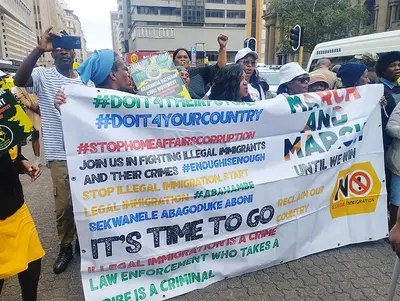
This is why the recent anti-illegal immigration protests should be understood in their broader context. They are not simply protests about migration. Like demonstrations over electricity shortages, water failures, unemployment, corruption and collapsing municipal services, they reflect a growing crisis of governance.
They reveal declining confidence in the state's ability to perform its most basic functions. When citizens increasingly believe that the government only responds after sustained public pressure, they begin to take matters into their own hands. That is not evidence of a stronger society. It is evidence of a weakening state.
This is why political leadership matters. Precisely because simplistic solutions will not restore public confidence. Illegal immigration cannot be solved through slogans, periodic raids or election-season promises. Nor can the issue be addressed by dismissing or denying community concerns and avoiding difficult conversations.
Responsible leadership requires acknowledging both the legitimacy of public frustration and the obligation to uphold the rule of law and constitutional rights.
A credible response rests on three principles. First, the government must restore the state's capacity to manage immigration effectively. Home Affairs requires sufficient personnel, modern biometric verification technology, stronger border management and efficient visa and asylum systems capable of distinguishing quickly between lawful and unlawful migration.
Second, enforcement must target the systems that make illegal immigration profitable. Employers who exploit undocumented migrants, corrupt officials who facilitate document fraud and criminal syndicates involved in human trafficking and smuggling must face meaningful consequences. Properly trained community safety structures may assist with lawful reporting and cooperation but they should never substitute for the state.
Third, immigration policy must be integrated with economic policy. Communities will not regain confidence while unemployment remains exceptionally high and labour exploitation continues unchecked.
The government must strengthen labour inspections, protect workers, enforce labour standards consistently and invest in meaningful economic opportunities, particularly in townships and rural communities. Immigration enforcement alone cannot solve problems rooted in economic exclusion.
South Africa's immigration debate should therefore begin with a simple recognition: illegal immigration is not the whole problem. It is one manifestation of deeper institutional failures. Weak governance, corruption, inadequate administrative capacity, labour market failures and declining public confidence have created an environment in which illegal immigration becomes both politically combustible and increasingly difficult to manage lawfully.
The choice before South Africa is not between open borders and “xenophobia”. Nor is it between compassion and law enforcement. The real choice is between continued institutional decline and rebuilding a capable state.
Only a government that can secure its borders, enforce its laws consistently, strengthen its institutions and protect the dignity of everyone within its borders will restore public confidence and manage immigration effectively.
Until that happens, South Africa will continue returning to the same painful cycle, public outrage, political promises and institutional failure, all while mistaking the symptom for the crisis itself.
Vuyo Zungula is a South African politician and the former president of the African Transformation Movement (ATM).




 English (US) ·