
 1 hour ago
1
1 hour ago
1
SEE YOUR AD HERE
In an interconnected world, a misleading or oversimplified narrative can quickly cross borders and become accepted as fact
31 JUL 2026, 00:00
4 min read

There is a saying in journalism that words matter. In today’s digital age, perhaps nothing is more true.
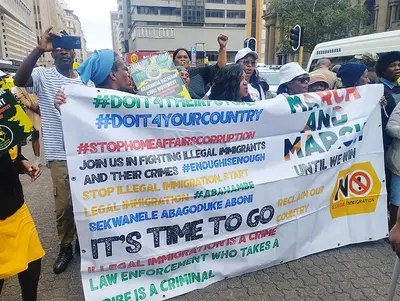
The recent anti-illegal immigration marches across the country have reignited difficult but necessary conversations on border management, crime, public policy, migration and social cohesion. They have also exposed the media’s power to shape public understanding.
The language used to report the events has influenced how South Africans are perceived globally. Many headlines framed the demonstrations as “anti-immigration” protests. Yet many of the organisers and participants described their position as being against illegal immigration, arguing that they were calling for stronger enforcement of immigration laws rather than opposing immigration altogether.
These are not identical concepts. One speaks to the legality and administration of migration. The other suggests opposition to immigration.
The distinction matters. Journa-lism has always carried a responsibility to distinguish between similar but different ideas. Precision is not a luxury; it is the foundation of credibility.
The issue extends beyond one protest or one news cycle. Headlines travel faster than nuance. For many audiences outside South Africa,
particularly across Africa, a headline may become their only exposure to what happened. That headline often becomes the story.
When simplified narratives spread internationally, they shape perceptions. South Africans may increasingly be viewed as hostile towards fellow Africans. Equally, concerns around immigration policy, border management or state capacity may disappear from the conversation because the broader narrative has been established.
This illustrates why journalism remains one of society’s most powerful institutions. It does not simply report events; it influences how the events are understood.
The challenge facing journalism is speed and competition. News organisations operate in an environment where breaking stories first often competes with getting them right. Digital platforms reward engagement, while algorithms reward emotionally charged content. Headlines are frequently optimised for clicks, shares and reactions before readers even reach the first paragraph.
None of this means journalists have abandoned professional standards. Countless reporters continue to produce accurate, balanced and courageous journalism, often under immense pressure. But the commercial realities of the modern media ecosystem make it difficult to balance speed, visibility and precision.
This is precisely why editorial judgement matters more than ever.
Responsible journalism is not simply about avoiding factual errors. It is about providing sufficient context to help audiences understand what is happening rather than merely reacting to it. It requires careful word choice, balanced sourcing and the discipline to separate verified facts from assumptions. When reporting on emotionally charged issues, the responsibility becomes even greater.
The consequences of imprecise reporting are significant. Narratives influence public opinion. Public opinion influences policy. Policy shapes diplomatic relations, investment confidence and social cohesion. In an interconnected world, a misleading or oversimplified narrative can quickly cross borders and become accepted as fact.
This is particularly important for South Africa, whose reputation affects everything from tourism and foreign investment to regional diplomacy and continental cooperation.
Equally, citizens also have responsibilities. The rise of social media has blurred the distinction between journalism and opinion. Many people consume news exclusively through headlines, short video clips or posts shared by friends and influencers. Context is often lost before an article is opened. Media literacy has therefore become just as important as media freedom. Readers should ask: Does the headline accurately reflect the story? Have multiple perspectives been presented? Is there evidence supporting the claims? What important context might be missing?
The conversation around illegal immigration deserves careful reporting. So too do discussions around border security, economic migration, xenophobia, labour markets, crime and regional mobility. None of the issues benefits from simplistic narratives or emotionally charged labels that reduce complex realities into convenient headlines.
Journalism has always played a central role in strengthening democracy because it informs citizens, holds institutions accountable and facilitates informed public debate. The role becomes diminished when precision gives way to speed or nuance is sacrificed for engagement.
As the media landscape evolves, responsible journalism should not be viewed as an outdated ideal. It is more necessary than ever.
In an era where misinformation spreads instantly and perceptions can be shaped in seconds, the public needs journalism that is accurate before it is viral, balanced before it is sensational and contextual before it is convenient. Journalism does more than tell us what happened. It helps determine what the world believes happened. The responsibility has never been greater.
Dumisani Ngwaila is a senior communications director. The opinions shared belong solely to him and do not represent the policy, position or endorsement of his employer, organisation or an affiliated entity.


 English (US) ·